
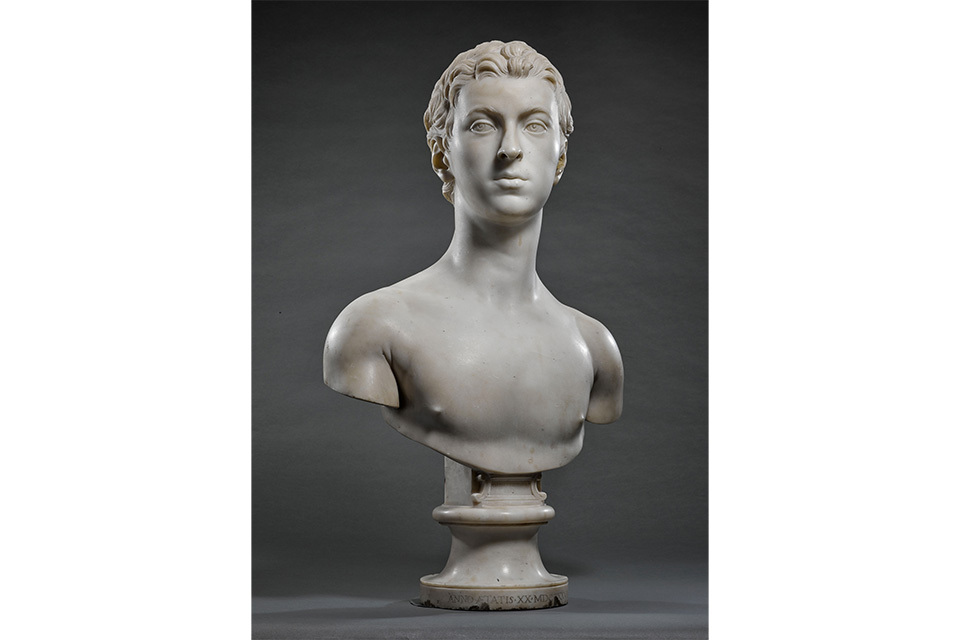
- The bust has been valued at £3.1 million (plus VAT of £620,000 which can be reclaimed by an eligible institution)
- Export bar is to allow time for a UK gallery or institution to acquire the bust
An export bar has been placed on an 18th century bust of John Gordon of Invergordon by Edmé Bouchardon in an effort to protect a key piece of the nation’s history.
The 18th century marble sculpture, signed and dated 1728, has been valued at £3.1 million and represents a work of outstanding cultural and historical importance to Britain.
The bust provides unique insight into Scottish heritage as it represents the only classicising bust of a Scottish aristocrat by Bouchardon from the first half of the 18th century. The sculpture demonstrates Bouchardon’s innovative approach to portraiture, combining classical typology with naturalism and psychological insight.
Sir John Gordon of Invergordon was a Scottish politician, important for his role as Member of Parliament. He succeeded his father as MP for Cromarty and served as Secretary for Scottish Affairs to Frederick, Prince of Wales, in the 1740s.
His family was also well known for their land ownership and development efforts which established the town of Invergordon, a key port on the Cromarty Firth. This famous marble bust of him, sculpted by Edmé Bouchardon in Rome is a significant piece of art and a tangible link to the town’s heritage.
It is one of only two classicising marble busts of British male sitters by the French sculptor, with the other not on public display, meaning the work is considered essential to understanding the development of 18th century British portraiture.
Culture Minister, Baroness Twycross said:
This bust has an extraordinary history.
I hope the temporary export ban will allow a UK institution or gallery to be found to keep this extraordinary sculpture in Britain.
Stuart Lochhead, member of the Reviewing Committee on the Export of Works of Art and Objects of Cultural Interest, said:
This remarkable marble bust of John Gordon of Invergordon by Edme Bouchardon tells a unique story about Scotland, Jacobite intrigue, Rome as a cultural crucible at the time of the Grand Tour, and a radical new portrait style.
Gordon is portrayed bare-chested, evoking some of the classical sculpture Bouchardon studied at the French Academy in Rome. This rare approach reflects the artist’s ambition to merge ancient nobility with eighteenth-century elegance.
A striking example of Bouchardon’s mastery and Scotland’s participation in the Grand Tour, the sculpture combines historical significance, rarity, and superb quality. This exceptional work of art deserves to be saved for the nation.
The Minister’s decision follows the advice of the Reviewing Committee on the Export of Works of Art and Objects of Cultural Interest (RCEWA).
The Committee made its recommendation on the basis that the bust met the first, second, and third Waverley criteria for its outstanding connection with our history and national life, its outstanding aesthetic importance, and its outstanding significance to the study of the history of 18th century sculpture in Britain and Europe and the sculpture and portrayal of aristocrats.
The decision on the export licence application for the bust will be deferred for a period ending on 8 April 2026 inclusive. At the end of the first deferral period owners will have a consideration period of 15 Business Days to consider any offer(s) to purchase the bust at the recommended price of £3,135,090 (plus VAT of £620,000 which can be reclaimed by an eligible institution). This price includes the cost of producing a replica of the bust. The second deferral period will commence following the signing of an Option Agreement and will last for five months.
Notes to editors
- Organisations or individuals interested in purchasing the sculpture should contact the RCEWA on 02072680534 or rcewa@artscouncil.org.uk.
- Details of the item are as follows: John Gordon of Invergordon By Edme Bouchardon (1698-1762), French 1728, made in Rome Marble Height 81; width 51 cm. Inscription, on the bottom edge of the left arm: Edmund. Bouchardon Faciebat Romae; on the cartouche: JOHN GORDON ESQ.R; around the base: ANNO.AETATIS.XX.MDCCXXVIII
- Provenance: Commissioned, probably by the sitter, and executed in Rome, 1728; John Gordon of Invergordon until his death in 1783; by descent, according to the Trust set up by John Gordon in 1776, to his nephew John Mackenzie, Lord MacLeod (d.1789) (listed in an inventory in 1785); probably thence by descent within the Mackenzie family; Kindeace House sale, Kindeace House, Invergordon, January 1930; where acquired by the Burgh of Invergordon Town Council January 1930 for £5; placed in Invergordon Town Hall, 3 February 1930; the bust is considered for installation in the Municipal Chambers of Invergordon Burgh in 1955; Ross & Cromarty District Council (having absorbed Invergordon Town Council) 1975; The Highland Council (having absorbed Ross & Cromarty District Council in 1999) on behalf of the Invergordon Common Good Fund, 1999-present
- The Reviewing Committee on the Export of Works of Art and Objects of Cultural Interest is an independent body, serviced by Arts Council England (ACE), which advises the Secretary of State for Culture, Media and Sport on whether a cultural object, intended for export, is of national importance under specified criteria.